



Your Travel Experience with Argentinien Pro
Day 1
Transfer
You will be welcomed at the airport by your dive guide and the crew will accompany you to the boat. Once on board you will have time to settle in and a briefing awaits you. You will also be explained what to expect during the next days and the rules on board.
Baltra Island
Afternoon: Today the first dive will be taking place, directly in front of the arrival island Baltra. Punta Carrion is often used as the starting point of a diving cruise through the archipelago, as it is a good starting point for a nice introduction to the underwater world of the nature park. Here you will dive along a reef with a mix of rocky and sandy areas. In between the boulders and in the reef you can discover a wide variety of marine life, including marine snails and tropical fish in a variety of colors. With a bit of luck you can also see mobula rays, hammerhead sharks, Galapagos sharks, sea lions, penguins and marine iguanas.
Depth up to 18 meters / visibility between 15 - 20 meters / currents are medium.
Day 2
Capo Marshall
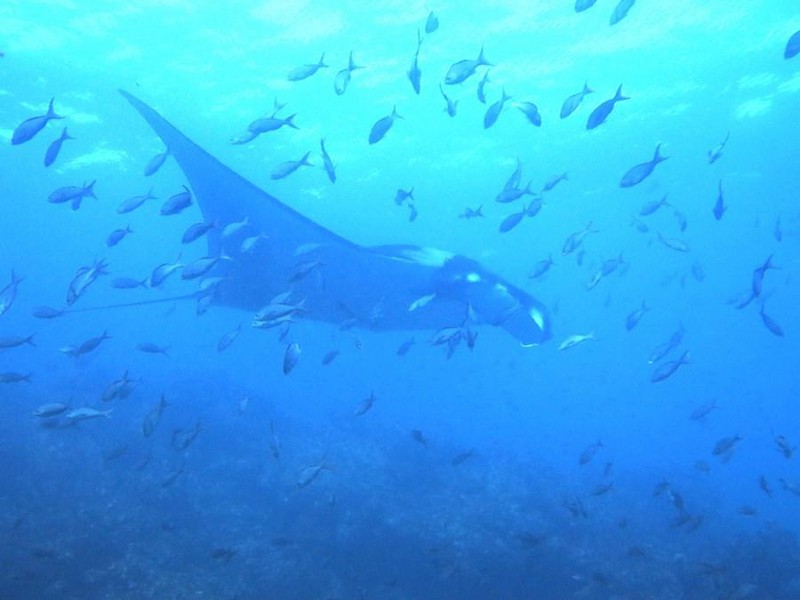
Morning: This fantastic dive site offers the best chance of spotting manta rays. You’ll descend into a spectacular underwater world, where a wall drops 30 metres or more into the depths. As well as manta rays, you’ll also see creole fish, barracudas, whitetip reef sharks, sea lions, yellowfin tuna, groupers, snappers and goldstripe fish.
20 ft. - 100 ft. dive with Giant Manta Rays, Creole Fish, Barracudas, White Tipped Reef Sharks, Sea Lions, Fur Sea Lions, Yellow Fin Tunas, Groupers, Snappers, Salemas.
City of the Mantas
Afternoon: A unique attraction near Cape Marshall’s is a spot where giant manta rays are sighted so frequently that it has been nicknamed ‘Manta’s City’. They roam the plankton-rich waters in search of food, which can sometimes limit visibility underwater. After returning on board the ‘Aqua’, we set course for Darwin, as the distance to be covered is quite considerable.
Day 3
El Arco, Darwin Island
Morning: Darwin Island and its dive sites are among the two most popular in the Galápagos Archipelago. Like Wolf Island, it lies somewhat apart from the other islands and offers fantastic views of the underwater world. The aim here is, after a quick descent, to secure yourself to the rock face with a drift hook and wait for the large schools of hammerhead sharks. El Arco is the best dive site on the uninhabited Darwin Island; here you will not only see large numbers of manta rays but perhaps also a few dolphins a little way out from the reef. Many of the fish that live here can only be found here, and with a bit of luck you may also spot whale sharks, which are unique to this location.
1 to 3 knot current; 40 ft. - 90 ft. dive with Schooling Scalloped Hammerhead Sharks, Galapagos Sharks, Silky Sharks, Eagle Rays, Green Turtles, Almaco Jack, Snappers, Groupers, Wahoo, Hawksbill Turtles and Whale Sharks. Occasionally Manta Rays and Orcas.
Darwin’s Theatre, Darwin Island
Afternoon: Two branching ridges extend from the reef foundations of Darwin’s Arch towards the north-east and south-east. Beneath the foaming waves, winding terraces coil around the northern spur, aptly named ‘Darwin’s Theatre’. It features a veritable grandstand with vantage points at a depth of around 18 metres, directly above the edge of a steeply sloping wall. The exposed rocks, encrusted with barnacles, are the perfect spots from which to enjoy the underwater spectacle of the whale sharks. Even when there are no whale sharks about, there is usually an endless parade of extraordinary marine life, including schools of hammerhead sharks, patrolling oceanic whitetip sharks, silky sharks, yellowfin tuna, wahoo, amberjack and pelagic fish, the latter forming swirling balls as they hunt.
1 to 3 knot current; 40 ft. - 90 ft. dive with Schooling Scalloped Hammerhead Sharks, Galapagos Sharks, Silky Sharks, Eagle Rays, Green Turtles, Almaco Jack, Snappers, Groupers, Wahoo, Hawksbill Turtles and Whale Sharks. Occasionally Manta Rays and Orcas.
Day 4
El Arenal, Darwin Island
Morning: The second dive takes place after lunch in the El Arenal dive site. Here, too, you can spot whale sharks, hammerhead sharks, rays, dolphins and many different species of fish. Rest assured that your dive guide will take you to the best spots and that you’re sure to catch sight of the full variety of large fish.
1 to 3 knot current; 40 ft. - 90 ft. dive with Schooling Scalloped Hammerhead Sharks, Galapagos Sharks, Silky Sharks, Eagle Rays, Green Turtles, Almaco Jack, Snappers, Groupers, Wahoo, Hawksbill Turtles and Whale Sharks. Occasionally Manta Rays and Orcas.
Coral Reef, Wolf Island
Afternoon: To make the most of all three days permitted in the vicinity of Wolf and Darwin Islands, you’ll be diving once more today in the waters around Wolf Island. During these dives, you’ll have the chance to take a closer look at the reef’s many corals and admire the small tropical ecosystem. More than eight species of coral and an incredible variety of fish live here. Of course, during these dives you might also spot one or two marine creatures that you didn’t see during the first two dives.
Depth up to 20 metres / Visibility often 30 metres / Current up to 3 knots, sometimes more
Day 5
El Derrumbe on Wolf Island
Morning: The descent along a rocky slope leads to natural vantage points at the edge of a cliff (at a depth of around 20 metres). These vantage points offer a front-row panoramic view out into the blue, where one of the archipelago’s most impressive shark spectacles takes place. Whilst holding on tight to the rocks, enjoy the sight of hammerhead sharks, visible from all angles, as well as some Galápagos sharks, which patrol the waters alongside silky sharks, blacktip sharks, spotted stingrays, shoals of pelican barracudas and much more. During the cold-water season (June–November), large whales such as orcas or humpback whales may make an appearance.
Depth up to 20 meters / visibility often 30 meters / current can be strong.
Pinnacle and the Caves, Wolf Island
Afternoon: This area, situated at the northern end of the main island, boasts some of the most beautiful caves in the Galápagos Islands as well as an exciting experience at the ‘Pinnacle’. It features four underwater caves that jut out from the island’s cliff face and are easily accessible provided the current is not too strong. The cave entrances are at depths of 15–21 m, and the seabed at the foot of the wall is sandy. Hawksbill and green sea turtles often gather in this area to be cleaned by fish, and you can spot them near the opening or as they swim in and out. The fourth cave has the largest opening, with an entrance at a depth of around 18 metres, and offers an interesting exploration, weather permitting.
Day 6
Punta Vicente Roca, Isabela Island
Afternoon: The first dive starts very early today at Punta Vicente Roca. Down below you will find large sea horses, living in pairs scattered throughout the coral. You may also find catfish, red-lipped batfish and the highlight of the day: the oceanic sunfish. This area is home to many sea turtles. After the dive you be taken to the shoreline to see the penguins, flightless cormorants and marine iguanas.
Depth up to 25 meters / visibility between 15 - 20 meters / currents are medium to strong.
Dive off the island Fernandina - Cabo Douglas
Afternoon: Cape Douglas is sure to provide you amazing opportunities to observe a large amount of marine life, above and under the water! As you prepare for your dive, you can see Galapagos Penguins, Galapagos Flightless Cormorants, and Galapagos Marine Iguanas- animals only found exclusively on the Islands. A sure sight is incredible marine iguanas swimming and feeding on the rocks under the surface. Some marine life you may see are: Red-lipped Batfish, Horn Sharks, Mola Mola, and possibly Baleen Whales!
Depth up to 33 meters / visibility between 15 - 20 meters / currents are medium to strong.
Day 7
Cousin Rock, Santiago Island
Morning: For many divers, this is the Mecca of the underwater world and its marine life. It is one of the best dive sites on Isabela Island and is situated in the south-east of the islands. Thanks to cool, nutrient-rich currents, there is an incredible variety of marine life here. As well as a wide variety of sharks, manta rays, eagle rays, sea lions and lobsters, you can also encounter a wide variety of tropical fish here. As not many boats visit this dive site, it offers a unique opportunity to explore one of the archipelago’s newest dive sites.
Depth up to 25 metres / Visibility between 15–20 metres / Currents are moderate to strong
Highlands of Santa Cruz
Morning: As the only island that makes all vegetation zones accessible to visitors, it is a great place for a little trip to the highlands. Already from the beach you will be welcomed by a magnificent flora and fauna that will follow you up to the highest point of the island. The bus tour takes you along the island's agricultural land and flows smoothly into the green, fog-covered forests. Here you will experience a strong contrast to the other islands, which have less altitude and more aridity. Together with your guide you will visit different places here in the highlands, like the giant tortoise reserve and the famous lava tunnels. Look forward to a breathtaking landscape and a short walk with unforgettable phenomena.
Day 8
Return to the Baltra Harbour
You will return to the harbor of Baltra. From there, transfer to Baltra Airport in time for your return flight to the mainland, or continue with your planned route through the Galapagos.